Radio Fox Box
1/23/2025

I am a part of the W5AC radio club here at A&M, and we have weekly events where we go out
"Fox hunting" which is the sport of tracking down (hunting) a transmitter that goes off every
few minutes. This is one of my favorite activities in Amature Radio, and I would have gotten
my license sooner if I knew about it.
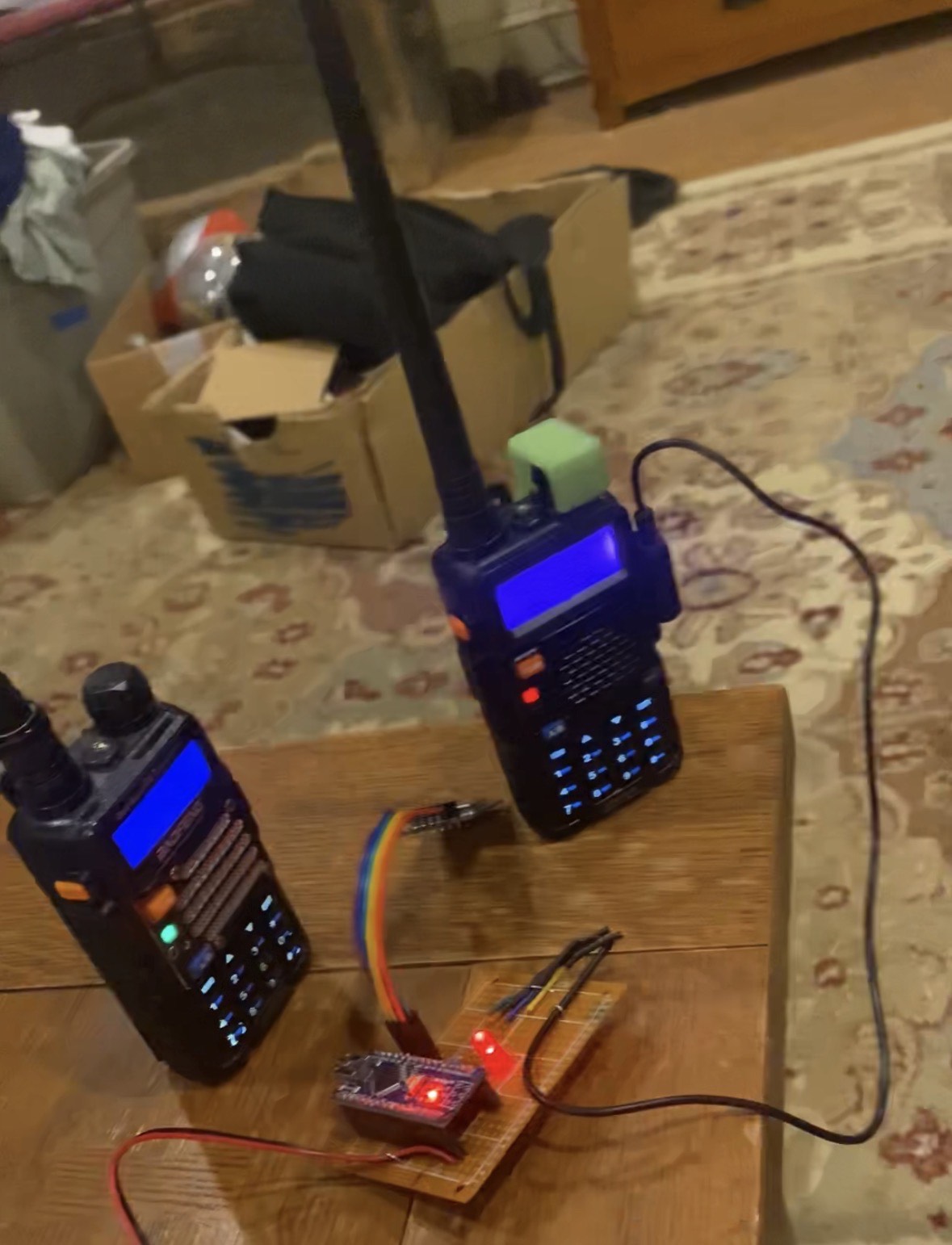
I wanted to build my own radio fox. The fox the club uses is a simple UV-5R (the same radio I use) attached to a Raspberry Pi running a script. It is set to play a random "wheatley" quotes from the game "Portal 2". So I decided to mimic these functionalities. What got me into the idea of actually building my own was me wanting to mix my hobbies together by getting my arduino to control my radio.
So I first checked to see if anyone else has done it, and they did! I got the basic circuit diagram and code from: Arduino Controlled Fox Transmitter W1RCP Ham Radio Gear. However, this only showed me how to connect the arduino to the radio and some basic code structure since this design only transmitted morse code. I did end up keeping a lot of the original code since I needed to transmit my callsign in morse code at the end of each transmission.
This left me to figure out how to transmit actual audio on my own. To connect my radio to the arduino I would need to sacrifice the earpiece cable the radio came with. This cable allows for audio in/out and PTT (transmit button) I wanted mine to be a lot like the clubs, so I wanted to transmit audio clips of Cave Johnson from the same game. To do this I would need an SD card reader. I read online about how to use it to play audio. So I hooked up the arduino, reader, and a speaker to be able to play some songs. Here's the library for the reader: SD - Arduino Reference.
A good amount of tinkering and testing later, I had a working Fox box on a breadboard, however, I need something a bit more permanent. So I grabbed some perf boards and my soldering iron and made it into a circuit board. Got it to work the first try too! I then printed out a bracket for it and put it in a water proof box. Unfortunately, I haven't field tested it yet. My one attempt, I ended up forgetting the battery and reversing the polarity when trying attempting to use a different battery frying the arduino. This has led me to installing a diode onto the circuit to prevent it from happening again, although this does decrease the battery life of the device itself.
I wanted to build my own radio fox. The fox the club uses is a simple UV-5R (the same radio I use) attached to a Raspberry Pi running a script. It is set to play a random "wheatley" quotes from the game "Portal 2". So I decided to mimic these functionalities. What got me into the idea of actually building my own was me wanting to mix my hobbies together by getting my arduino to control my radio.
So I first checked to see if anyone else has done it, and they did! I got the basic circuit diagram and code from: Arduino Controlled Fox Transmitter W1RCP Ham Radio Gear. However, this only showed me how to connect the arduino to the radio and some basic code structure since this design only transmitted morse code. I did end up keeping a lot of the original code since I needed to transmit my callsign in morse code at the end of each transmission.
This left me to figure out how to transmit actual audio on my own. To connect my radio to the arduino I would need to sacrifice the earpiece cable the radio came with. This cable allows for audio in/out and PTT (transmit button) I wanted mine to be a lot like the clubs, so I wanted to transmit audio clips of Cave Johnson from the same game. To do this I would need an SD card reader. I read online about how to use it to play audio. So I hooked up the arduino, reader, and a speaker to be able to play some songs. Here's the library for the reader: SD - Arduino Reference.
A good amount of tinkering and testing later, I had a working Fox box on a breadboard, however, I need something a bit more permanent. So I grabbed some perf boards and my soldering iron and made it into a circuit board. Got it to work the first try too! I then printed out a bracket for it and put it in a water proof box. Unfortunately, I haven't field tested it yet. My one attempt, I ended up forgetting the battery and reversing the polarity when trying attempting to use a different battery frying the arduino. This has led me to installing a diode onto the circuit to prevent it from happening again, although this does decrease the battery life of the device itself.